
Nose Surgery

Transform Your Look with Expert Nose Surgery at DCH Hospital
Rhinoplasty is one of the most impactful cosmetic decisions you can make. For many, expert nose surgery serves as a trusted first step into aesthetic enhancement. This precise procedure harmonizes your facial features, creates striking definition, and ultimately brings out your authentic, natural charm.

Why is Nose Surgery popular?
Expert nose surgery does more than just refine your appearance; it fundamentally transforms your facial balance. A beautifully proportioned nose instantly elevates your self-confidence and empowers your everyday presence. With a variety of advanced rhinoplasty techniques available today, every procedure is meticulously customized to complement your unique facial structure and personal aesthetic goals.
Open Rhinoplasty for Structural Refinement For individuals seeking absolute precision, Open Rhinoplasty safely reconstructs the entire nasal framework to achieve the perfect golden ratio of facial proportions. This comprehensive method allows specialists to carefully reshape the nose and remove excess tissue at the tip, drastically reducing long-term risks like thin skin or visible implants. Beyond pure cosmetic enhancement, this advanced structural approach serves as the ultimate solution for correcting congenital abnormalities or repairing post-traumatic deformities.
At DCH, our golden ratio approach measures the face into thirds: 1/3 (forehead), 1/3 (chin), where the nose section is slightly shorter to give a softer, more delicate look.

Is Nose Surgery the Right Choice for You?
- Resolving Structural Concerns: Individuals dealing with a crooked, flared, or deviated nose who desire a perfectly symmetrical and balanced profile.
- Restoring Facial Harmony: Those looking to seamlessly enhance their natural proportions, correct facial imbalance, and significantly boost their overall self-confidence.
- Improving Daily Functionality: Patients experiencing restricted airflow or breathing difficulties caused by internal nasal abnormalities.
- Achieving Aesthetic Goals: Anyone seeking a refined facial transformation such as a higher, more defined bridge or a slimmer tip meticulously customized to complement their unique features.

Types of Nose Surgery – What’s the Difference?
Nose Surgery primarily rely on two foundational rhinoplasty techniques: Closed and Open.Although clinics advertise various names, these typically represent combined surgical methods or personalized aesthetic enhancements.

Closed Rhinoplasty
Closed rhinoplasty is performed through incisions inside the nostrils, resulting in no visible external scars. It’s suitable for minor adjustments or simpler reshaping and ideal for first-time procedures. Recovery time is relatively short, though the resulting nose shape may be less dramatically defined.
- Advantages of Closed Rhinoplasty:
- Incisions are made inside the nostrils – minimally invasive
- No visible external scarring
- Short recovery time
- More affordable than open rhinoplasty

Open Rhinoplasty
Open rhinoplasty involves making an incision between the nostrils to lift the nasal skin, giving the surgeon a full view of the internal structure. This method is ideal for more complex corrections. It requires general anesthesia and must be performed under close supervision by an anesthesiologist. This approach allows for precise reshaping of the nasal framework.
- Advantages of Open Rhinoplasty:
- Better visibility of nasal structures for more precise correction
- Suitable for complex cases or major reshaping
- Allows for cartilage grafting and extensive structure modification
Rhinoplasty Techniques at DCH Hospital
At DCH Hospital International Center, we offer advanced rhinoplasty techniques tailored to each individual’s facial features and needs. We use the proprietary DCH technique, which includes three popular nose shapes and methods.

DCH Semi Open Technique
This technique is a hybrid between closed and open rhinoplasty. It involves small internal incisions on both sides of the nostrils to allow better positioning of the silicone implant along the nasal bridge and to remove excess fibrous tissue. This method typically uses an L-shaped silicone implant, combined with nose-tip support using ear cartilage, coccyx cartilage, or artificial tissue to reduce the risk of tip thinning or transparency. The procedure takes approximately 1 hour.
- Advantages of the DCH Semi-Open Technique:
- Reduces the risk of nasal deviation
- Short operation and recovery time
- Allows for interdomal suturing, creating a more refined nose tip angle

DCH Open Rhinoplasty Technique
This is an open rhinoplasty technique (Open) that involves restructuring the nasal framework. It is suitable for individuals with structural nasal issues such as a deviated nose, bulbous nose tip, nasal hump, a history of nasal infections, cleft lip and palate cases, or for those who desire a more defined yet naturally soft Korean-style nasal projection. This procedure requires general anesthesia (as it is considered major surgery) and must be performed under the supervision of an anesthesiologist. The surgery typically takes around 2 hours, depending on the complexity of each case.
- Advantages of the DCH Open Rhinoplasty:
- Suitable for all types of internal nasal structure problems
- Reduces the risk of silicone deviation and extrusion
- Naturally sharp and refined nasal tip

DCH Rib Rhinoplasty Technique
This is also an open rhinoplasty technique that involves reshaping the nose using rib cartilage rhinoplasty. It employs a similar approach to the DCH Open Rhinoplasty but allows for maximum extension of the nasal septum due to the strength of the rib cartilage. It provides long-term safety and involves the use of the patient’s own rib cartilage, completely free from silicone (100% silicone-free). The surgeon carves and shapes the rib cartilage to suit the original nasal structure to achieve a smooth and natural-looking nose. This procedure also requires general anesthesia and is conducted under the care of an anesthesiologist. The surgery typically takes around 3 hours, depending on the complexity of the case.
- Advantages of the DCH Rib Rhinoplasty:
- No concerns about infection; 100% silicone-free and safe
- Allows for maximum extension of the nasal septum for a sharper nose tip
- Beautiful nasal shape with strong, safe, and long-lasting results
Difference Between
DCH Semi Open VS DCH Rib Rhinoplasty

FAQ: Nose Surgery
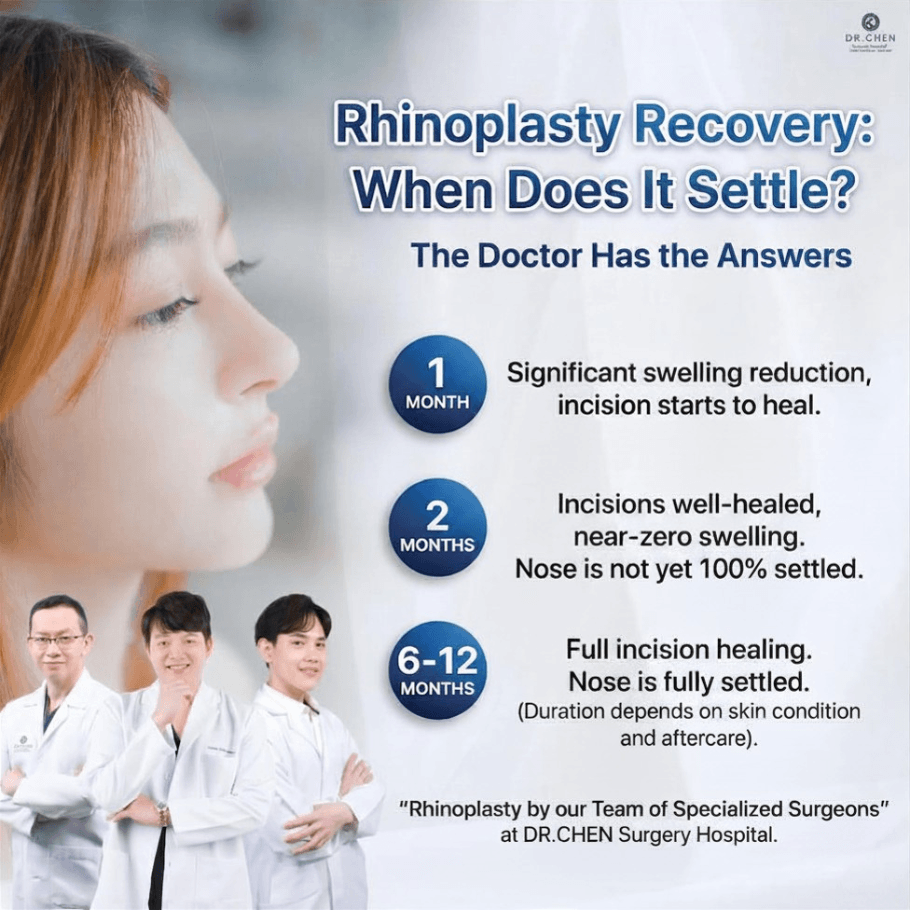
How long does it take for the nose to settle after surgery?
While you will see great results quickly, full rhinoplasty recovery takes up to a year. Here is the timeline:
1 Month: Significant reduction in swelling; incisions start to heal.
2 Months: Near-zero visible swelling; incisions are well-healed.
6-12 Months: Full internal healing; the nose is 100% settled into its final shape.
Note: Your exact healing time will depend on your individual skin condition and post-operative aftercare.
7 Self-Care Tips After Rhinoplasty
- Keep the wound dry before stitch removal.
Avoid getting the surgical site wet to reduce the risk of infection. - Avoid smoking and alcohol.
These can damage cells and significantly slow down the healing process. - Sleep with your head elevated or use a neck pillow.
This helps minimize swelling and promotes better drainage. - Apply cold compress during the first week.
Helps reduce swelling and support blood clotting. - Switch to warm compress after the first week.
Promotes blood circulation and helps with residual swelling. - Take all prescribed medications and supplements.
Follow your doctor’s instructions, and consider taking HELIK (a swelling-reduction supplement) to speed up recovery. - Apply scar-reducing ointment after stitch removal.
Helps reduce redness and softens the scar for smoother healing.
Pre-Surgery Guidelines for Rhinoplasty
- Inform your doctor of any underlying medical conditions
This allows for proper medication planning and risk assessment. - Avoid vitamins, supplements, and alcoholic beverages
These can interfere with anesthesia and healing. - No food or drink at least 8 hours before surgery
This is essential for safety during general anesthesia. - Do not wear makeup, nail polish, or contact lenses on the day of surgery.
- Remove all jewelry and metal objects
These can interfere with surgical equipment and increase risk. - Refrain from smoking for at least 2 weeks prior to surgery
Smoking hinders circulation and slows healing.


